JD Jugs works with a team of Master Craftsmen to produce our bespoke cylinders.
We've scoured Australia to find the best in the business, and we can't praise these guys enough...
- Paul of Friswell Pty Ltd Pattern Makers in Bendigo
- Daniel, Adam and Wayne at Machtech Australia in Tullamarine
- Adam, Paul and the lads at Hasco Foundry in Ballarat
How it all started
Being an early motorcycle enthusiast, I spend a lot of time at bike shows, rallies and historic motorbike races and searching the internet for rare and exotic bikes.
When I first started noticing old bikes it seemed amazing to me that there were so many F/FD and J/JD models out there in circulation. But you have to consider this: between 1915 and 1929 F and J model production ranged from 10,000 and 21,000 twins per year, with production peaking at 21,000 in 1920. Between 1921 and 1929 FD and JD production ranged between 2,000 and 11,000 with 1928 being the highest production year.
Over the years I began to notice that the number of early bikes at shows, races and rallies was dwindling. Talking to fellow devotees I began to discover that certain parts were becoming harder to source, keeping bikes off the road and owners frustrated. Everyone I spoke to had a ‘project bike’ that they would like to complete, but the one thing F and J model enthusiasts have in common is a lack of access to original spare parts.
In 2003 I started restoring my first J model. Working from a 1925 F 61ci magneto model Basket Case up, I easily sourced the parts I needed, but I couldn’t get my hands on any decent cylinders. By 2009 I had restored a couple of complete bikes and accumulated numerous frames, engines, parts and fellow enthusiasts – all of whom seemed to have the same problem... no cylinders.
The only choice we have had to date is to repair what we have... but the number of people who can repair fins and weld threads and exhaust valve seats are dwindling, their work is very time consuming and thus expensive, and at the end of the day, you are repairing 80 – 100 year old metal.
I know a few of you have tried and had some success with sleeving these barrels – but a lot of you have not - and the question of longevity and reliability has to be raised. When you look at a cross-section of a cylinder, the metal is thin and the amount of heat generated by the inlet-over-exhaust design is quite high. Although sleeving is common, modern highway speeds combined with the age of the cylinders makes this a recipe for disaster in my book.
In mid 2009, wanting to participate in historic motorbike racing, I started my quest for a functioning set of cylinders in earnest. I searched for quality cylinders Relentlessly online, I trawled swap meets; I drove friends and fellow aficionados insane.
I had exhausted all the available options. Following one particularly depressing conversation with my friend Tony Scherger, in desperation we started playing with the idea of making our own cylinders – and so began JD Jugs.
Not really knowing what was ahead of us, and needing some manufacturing advice, Tony and I approached my mate David Gill to see if our dream of authentic replication was possible.
David is a second generation engineer. The family fabrication and maintenance business - Gill Engineering - has been operating since 1956, working in areas as diverse as aviation, rail transport, road transport and paddle steamers, the oil / gas petrochemical industries, Department of Defence, wineries, sand blasting, canneries, packaging, recycling, car makers and many other general manufacturing industries.
Their product range includes, amongst other things, pressure vessels, pipe work and valving, gantries, sandblast cabinets, pressure pots, wine vats, food grade stainless steel pipe work, robotic support frames, safety guards and rails, stainless bench tops, machinery shafts and bushes and aircraft tow bars.
Gill Engineering works with carbon steel in all its forms of hardness and tensile strength, stainless steel, aluminium, phosphor bronze and Perspex.
With all this manufacturing experience behind him, and surprising us both, David was very excited about the idea, and while warning us it would be a difficult and frustrating journey – wanted in! Tony, David and I were in business... or at least the planning phase of a business.
After countless months of research into methods and materials I set out to find a pattern maker and a foundry – two more vanishing art forms – that could understand and make what we needed.


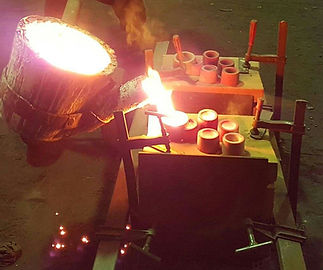


Finding a foundry that had the knowledge and equipment to cast up the cylinders ended up being easier than finding an artist to make the patterns. After a little bit of investigation, I stumbled across Beckwith Macbro Foundry, a third generation foundry with over seventy years experience and the ability to meet all our requirements, including our Goldilocks ‘not too hard, not too soft... it is just right’ iron recipe.
Beckwith MacBro Foundry dates back to 1930 when Alan Beckwith started work as a moulder. In 1960 he formed his own business to supply cores and moulds to the foundry industry. From these small beginnings the company has grown into a large, diverse company that sells to foundries throughout Australia, New Zealand and Asia.
This is a modern foundry that incorporates old and new technology. It is fully equipped with a modern moulding plant, electric melting and processing equipment, capable of producing castings from a few grams to 1200 kilograms. The foundry designs, supplies and manufactures foundry products, including the range of MACBRO sand mills, shell moulding machines and shell core equipment shop, resin coated sands facility, and a Thermal Reclamation Plant, to service both in-house requirements and the foundry industry.
Having finally sourced a foundry that I felt confident was more than equipped to meet our needs; I continued my search for a pattern maker.
Through friends of friends I was introduced to Keith Willmot, a veteran pattern maker with over 40 years of experience with early Triumph’s, Indian Chiefs and Four-cylinder Indians under his belt. Working with Keith and the foundry we created a set of cylinders that were technically correct, but just didn't look right.
After we had cast the prototypes, Keith excused himself from the project and a mate of mine, John Trease put me onto Neil Kilner from Accurate Patterns.
Well respected and known in the historic motorbike world, Neil had worked with Horner Brother’s Irving Vincent’s, John Trease 155ci Renegade 248hp V-twins, Arundel/Urquhart OHV Indians and the Drysdale V8 Motorbikes – but this was his first foray into earlier models from the teens and twenties.
Neil had a good look at what we had produced, and while he admired the craftsmanship behind it, he felt it would be easier for him to start from scratch. Although it seemed monumental at the time, this now minor set-back was actually a disguised blessing given the quality of the end product.
Neil was a true genius with old-school skills. After scrutinizing the different sets of 1920-1929 61ci cylinders we had on loan from Neville Hunter - which he had accumulated over fifty-odd years of being a J enthusiast and without whose vast knowledge we would not have been able to start – we began reverse engineering the cylinders, creating patterns the way they were made 100 years ago.
Following the tried and true methods of the old masters, Neil created the patterns out of wood, allowing for the shrinkage of the cast iron that occurs as it cools in the sand mould.
The work was incredibly challenging - the coring in between the exhaust port and cylinder wall was almost as difficult as the internal coring for the ports and combustion chamber.
About a year into this work, Neil became unwell and was unable to continue. After learning of Neil’s illness, the guys at the Foundry put me onto Dave and Pete at Advanced Patterns. Advanced Patterns has an incredible resume, with their industry successes including patterns for engine blocks, cylinder heads, manifold turbo housing and garret bell housing. Between them, these two have about 75 years of experience; David has been a pattern maker for just over 40 years, while Peter is a relative newcomer to the industry, with only 35 years of experience behind him!
Dave and Pete took over from Neil, sorting out the teething problems and finishing the 61ci patterns before starting work on the 74ci replacement cylinder patterns.
The 74ci replacement cylinders were fitted to some 1929 74ci twins and were manufactured as replacement parts after 1929 (1923 and 1924 DCA and DCB motors, 1925 to 1929 74ci twins). From the production year onwards, it was commonplace for bikes to operate with one or more of these cylinders after having an original cylinder or cylinders fail.
Despite this, I had found 74ci cylinders harder to source, and didn't actually own any myself. In order for Advanced Patterns to complete these patterns, I needed to provide them with a few sets to play with. I ended up sourcing a few sets on the web, buying a set from Steve Lippolt (Maryland - USA), and borrowing some from Steve Raffills (New Zealand) and Ken Andison.
Using the reverse engineering techniques from the 61 patterns definitely made it easier for Dave and Pete, but there was still well over 1,000 hours of work in making the patterns for the 74 cylinders.
Beckwith Macbro is staffed by experts whose qualifications and industrial experience were highly utilised and valued during the pattern making and initial casting process. Their staff were – and are - able to assemble the intricate patterns comprised of thirteen core boxes per cylinder. Assembly takes the ‘experts’ about 50 minutes per cylinder mould.
The foundry has a materials testing laboratory on site with facilities to do microscopic examinations, hardness testing and spectrometer chemical analysis and were able to have tensile testing done for us. They were able to do small runs for us, producing an outstanding quality and finish, and metallurgy.
At the end of our first run we had four sets of cylinders to experiment with. Gill Engineering chopped up a couple of sets to check thicknesses, and we gave two sets to my friend Paris Acott of Acott Race Craft to machine up.
Having known Paris for thirty years, I had followed his career in the racing car industry − both in the United Kingdom and the United States of America − with keen interest and admiration. In the late 1990s Paris returned to Australia, and continued
working with racing teams here. Building on his professional successes and the industry recognition and respect he had gained over the decade he had been involved in the sport; he started Acott Race Craft and began fabricating and suppling components to the racing industry.
Veering a little from the traditional path followed throughout our production process, Paris employed some old and new technologies in machining up our cylinders. Combining the technology of a CNC machine with the skill required to hand machine the cylinders, Paris brought this monumental dream one step closer to realization.
Once we had a set of fully machined and functional cylinders, I began the trialling phase. Fitting the cylinders to my 1925 F – the bike that started all this trouble – I began putting hours and miles behind me in all weather conditions and in all types of road conditions. I tested the cylinders on a hot, Australian summer day, when temperatures reached over 45 degrees Celcius (113 Fahrenheit), and I (stupidly) braved a pouring, stormy 10 degree Celcius autumn afternoon.
The bike and I have successfully put numerous miles on the clock over the last few years, and the cylinders just keep performing.
I know how hard this process has been, even with all the benefits of modern technology and the knowledge of the past behind us. It is staggering to think of the labour and skill the original manufacturers employed in casting 40,000 odd cylinders in one year, considering they were cast in green-sand (a mix of sand, clay, ash and horse manure), and machined by hand by machinists standing in cylinder lines comprised of turret lathes and special purpose machinery.
This whole project would not have been possible without the years of experience and knowledge stored in the brains and souls of our production team, and the dedication of all my friends involved on the fringes of the project. Tragically Neil passed away before seeing this project to completion, and we have felt his loss every step of the way since. But we have produced a product that I feel certain Neil would have been proud to be associated with, and after seeing our products, I am sure you will agree the work - and the end product - is exemplary.
As of 2026, JD Jugs shifted to Hasco Foundry and Machtech Australia for our casting and machining needs.